How to effectively use operant conditioning’s positive reinforcement through the implementation of behavior boards
If you went to college for psychology, education, or almost any other liberal arts major, there is a good chance you were introduced to the great behaviorist/psychologist B.F Skinner at one point or another. Most likely, this same class that introduced Skinner’s “classical and operant conditioning” theory contained a lab component that expected you, as a young 20-something year old college student, to train a virtual rat how to do a somersault #skinnerbox101.
Huh?
I admit, it is strange my university trains virtual rats (endearingly named “Sniffy”) to do flips using positive and negative reinforcements… but the university banned the use of live rats several years ago due to ethical reasons.
Moving on,
Skinner is known for changing the behavior of rats through using operant conditioning which had three main components; positive reinforcement, negative reinforcement, and punishment. If you would like to refresh your Skinner Box knowledge or further indulge in the world of rats doing flips, please read further here.
Now, how this applies to the world of education/psychology:
The status quo for many parents, educators, and school systems involves responding to students’ problematic behaviors with some form of punishment. This punishment can range anywhere from a negative verbal command such as “No!” to taking away a student’s privileges. (Just so you’re staying woke, 22 states still allow corporal punishment in school as of 2017– see here). Those who are familiar with Skinner’s research or have reacted to a student/child in this way can attest to the fact that punishment will not correct the problem behavior in the long-term. Although positive reinforcement is easier said than done (as Skinner’s “operant conditioning” theory was tested on rats in place of children), it is 100% possible to implement in any environment and 110% worth your efforts.
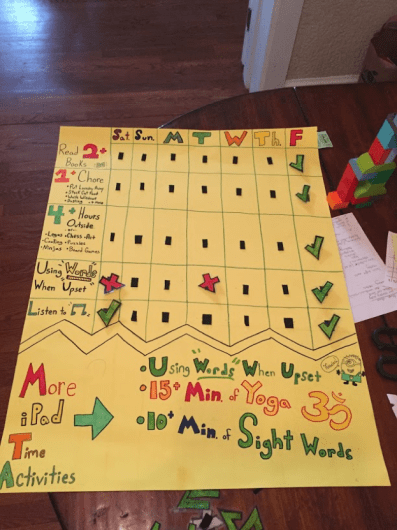
As just one example of positive reinforcement, please reference the picture I took of a behavior chart (located at the top of this article). Over the past summer I nannied a six-and-a-half-year-old boy with high functioning autism and ADHD. For the sake of this article, I will address him as “A”. Like most kids living in the 21st century, A is obsessed with his iPad. This obsession made it hard to transition to activities that do not involve a screen, even when he loved the other activities at hand. I have started to write a lot about why and how the iPad is a problem for this child in particular, but that will be a later post.
The important thing is that this boy genuinely loves other activities, such as Legos and Pokémon. He finds so much joy and pride in building Lego sets or organizing his cards by himself. Unfortunately, he has had unstructured and unlimited iPad time for years. As a result, screen time is his norm and he must relearn how to go about his day without depending on the iPad.
SO – I created an environment of positive reinforcement through the use of verbal praise, visual reminders, and incentives for positive behavior!
The most important aspect of positive reinforcement? Mutual respect.
I always make sure to give this boy 100% of my respect and empathy. It is important to remember that children usually do not lash out or have problem behaviors because they want to, but because they may have other means of communicating their frustrations and desires. This communication is learned, which is why I emphasize, “Using WORDS When Upset”.
I also make sure to compromise from time to time. For example, A strongly dislikes listening to music. His mother explained he grew up almost never hearing music, and the sound is now irritating to him. This may become a larger problem as he is exposed to more music through the years, so I decided we can work on it over the summer. Last week, he had NO desire to listen to music. Instead, we talked about it (reinforcing communication skills!) and mutually decided to try music next week and supplement the “Listen to Music” task with 15 more minutes of yoga (mindfulness is great for his ADHD too)!
If you feel this method may benefit someone in your life, please check out a post I recently published, outlining how to create your own behavior board!
 Empathetic Education