How To Make Your Own Behavior Board
For background, this past summer I was an aide for a six-and-a-half-year-old boy with ADHD and high-functioning autism (for the sake of anonymity, he will be mentioned as “A”). Between A’s parents, A, and myself, we created behavioral goals for the summer. I then turned these goals into a tangible activity through the use of a behavior board. To read more about behavior boards; see my most recent blog post.
2. What is the GOAL of your behavior board?
For example, the board created by A and I has several important elements and goals:
- Lower iPad Time – Through lowering time, we are reintroducing “A” to activities he enjoys. The hope is that over time he will be accustomed to less technology time and instead will be naturally drawn to the alternative activities he likes.
- Learn to Work for Rewards – A’s family has always given him Legos, toys, etc. on command. I have absolutely 0 judgement towards this, as A enjoys the activities and really appreciates and gains from them. That being said, he is not used to waiting or working towards incentives. SO, this board is to teach him to work towards things he wants.
- Increase Communication Skills – Because A has such severe meltdowns, his parents have needed to use the only resource that calms him down (which is usually the iPad… positively reinforcing the meltdowns).
- A has not needed to ask or communicate his frustrations before. The emphasis on using words when upset is to push A to talk about what he would like and compromise instead of taking over a situation through meltdowns.
- Promote Physical Activity – there is an emphasis on Yoga because A has ADHD and tends to have a lot of energy. His parents and I hope that through meditation & yoga A will not only be healthy physically, but will mentally be able to process his feeling and emotions in a more controlled manner.
2. After detecting goals, decide what you would like the student to work on/improve and write your goals into activities.
Side note: This process is a great opportunity to demonstrate the respect you have for your student/child. Through working together and listening to their input, you’re creating an effective partnership! Ultimately, this board is all about their needs.
Our activities included:
- iPad time will be lowered naturally through completing other tasks on the board that don’t include technology.
- Tasks include:
- Chores, Reading, and the generic “4+ hours of activity outside or non-technology based” activity block
- Tasks include:
- This goal of working for rewards will be naturally achieved when he completes tasks on his own time.
- I decided each activity = 1 point. As soon as A reaches 15 points, he is able to gain a reward (for us, this means purchasing a new Lego kit).
- Increasing communication comes from an emphasis on “Using Words When Upset”. If he communicates well with no breakdowns, he gets a check mark. If he continues to use great communication, he can gain more iPad time. Even after one week, A and I have had heart to heart and respectful conversations about using his words instead of having a meltdown. I tell him I have high expectations because I know he is smart, and that I expect the same level of respect that I give to him.
- Physical activity will be promoted through incentives like Yoga and outdoor time, both in which he can gain points for participating in.
Side note: In the nature of positive reinforcement, he does not lose any points for not completing an activity. He can only gain points.
3. Make sure to reinforce and stick to your agreement:
- “A” can only receive new games/Legos if he collects 15 points. Otherwise, there would be no real incentive for A to go through with the given activities.
- I also make sure to give verbal cues and verbal positive reinforcement throughout the day. This keeps moral high and lets A know I am there to support him.
- His parents will keep track of his activities on the weekends when I am not present as to reinforce the importance of the activities.
4. Make the physical board:
- This may be self-explanatory, but I just want to point out that I bought all the supplies at Michaels Craft Store.
- Velcro was extremely helpful! This way I could Velcro the backs of the X and ✔ so they are reusable!
- I also tape the ✔ & X pieces on both sides as to preserve them for a longer period – It’s like an at-home laminating machine!
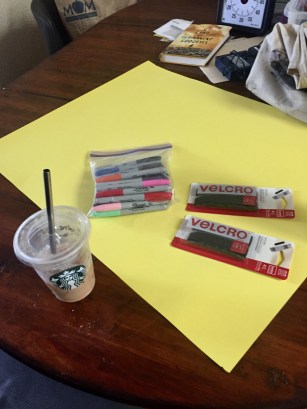 Before: Very beginning stages of the board ft. lots of Velcro and Sharpies! Also peep the timer in the back (perfect for achieving certain goals, such as limiting & tracking iPad time) and the book “The Land of Permanent Goodbyes” by Atia Abawi (an INCREDIBLE book about a strong Syrian family fleeing war, I highly recommend it).
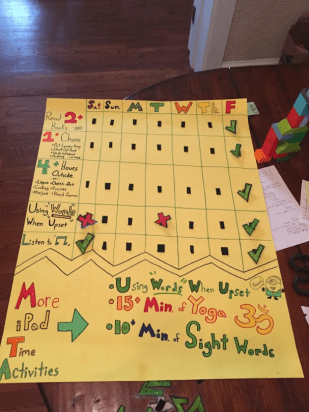 After: I took a lot of time to make the board colorful and fun!
There are COUNTLESS ways to make a behavior board but this is the structure of ours:
- Each day, “A” is able to gain up to 5 points. 1 point for each task.
- Once the task has been completed he can go over to the board and put a check mark next to that particular task.
- The check marks & x’s are held up by Velcro (Thank you Michaels Crafts!)
- At the end of the day, we will put an “X” next to any tasks that were not completed
- In the nature of positive reinforcement, he does not lose any points for X’s, just gains for the check-marks.
- Once he achieves 15 points, we can go to the Lego store together and pick out a set (pricing based off of what his parents feel is appropriate).
 Empathetic Education