A Student’s Reflection and Insight on Student-Faculty Partnerships
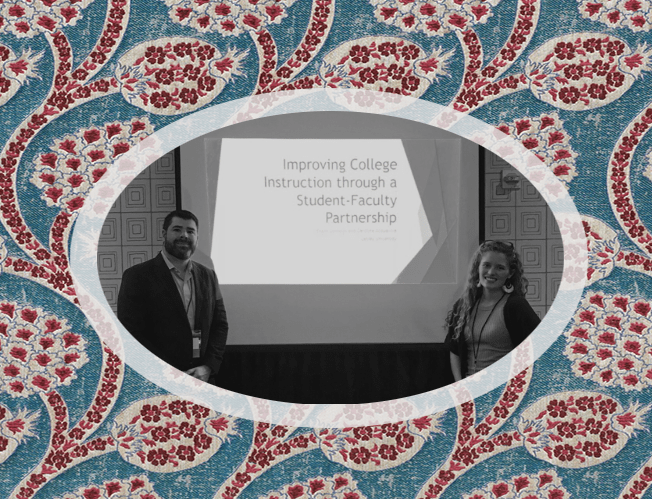
Frank and I presenting our work at the NERA 2018 Annual Conference
As an education major I have heard the expression, “Those who can’t do, teach” more times than I can count (#got’em). Although this phrase is said in good humor, there is actually some truth in the statement when it is reversed: “Those who can do, can’t teach”. I’m not saying people who fall under the “can do” category are incapable of teaching with best pedagogical practices, but I’m also not saying that anyone can walk into a school and instantly be a quality, effective teacher.
Either way, I have been fortunate enough to double major in Secondary Education & English at Lesley University, spending much of my time within the walls of the Education Department. I say fortunate because a majority of my professors have spent years as in-service teachers, instructing in classrooms ranging from private to public, rural to urban, elementary to high-school. In comparing my higher-education experience with peers who attend other universities I am grateful that majority of my professors have engaged in teacher-preparation programs. My classes with former in-service teachers tend to be more engaging, seeing that they are experienced and have taught in a range of diverse classrooms. These same professors are not only passionate about fostering an environment that teaches and discusses best educational practices with pre-service students, but they are enthusiastic in implementing these same practices in their own classrooms at the university level.
Lesley University’s culture may be considered unique and personal in the world of higher education. Just as an example, many students address faculty by their first name and the overall culture emphasizes respect and correct use of an individual’s pronouns. That being said, Lesley may not be unique in the way that faculty engage in professional development.
Since the establishment of our student-faculty partnership back in 2017, Professor Frank Daniello and I have explored ways to improve faculty instruction while simultaneously creating a more learner-centered academic culture at Lesley. Our partnership highlights just one way that those within the Education Department at the College of Liberal Arts and Sciences are working to improve faculty professional development and overall community engagement at Lesley. Through briefly explaining these collaborations between students and faculty, myself and those within the Education Department hope that students and faculty across all the diverse colleges and departments here at Lesley will be moved to engage in similar partnerships centered on teaching and scholarship.
What is a student-faculty partnership?
I mention that together Frank and I formed a student-faculty partnership, but you may be wondering about (a) the purpose of this type of partnership and (b) the logistics of what this partnership looks like when actually implemented.
The basis of our unique partnership was to collaboratively discuss Frank’s teaching practices, which was influenced by my perspective (AKA the student-lens). That being said, student-faculty partnerships are extremely context-dependent so there is no one, cookie-cutter way to implement this type of collaboration. The institution, subject, time-frame, and individuals who make up the partnership itself will influence each groups’ process and effectiveness.
In our partnership, Frank asked that I be a TA for his course while simultaneously working as a student-partner, meeting outside of class time to discuss my observations of Frank’s teaching practices. By doing this, Frank was able to engage in professional development with no costs (as I was receiving undergraduate course credit for my time as a TA en lieu of being paid). Throughout the duration of our partnership, Frank and I met weekly to not only discuss my observations of his practice but to address issues such as the power-dynamic between students and faculty. Our process in confronting this concept, which can obstruct honest conversation between partners, was vital in making sure I felt comfortable as the student to give my honest opinions and even recommendations for Frank’s practice. With student-faculty partnerships, it is important that all members acknowledge the unique expertise that each partner brings, and that one perspective is not necessarily more valuable than the other.
Student Rational for Engaging in a Student-Faculty Partnership:
As an undergraduate student in the teacher-education program at Lesley University, I have been repeatedly told the importance of critical self-reflection of my lesson plans, unit ideas, and overall pedagogy when it comes to teaching. Not only does Lesley stress this importance, but scholars articulate the effect of critical self-reflection on deeper and emancipatory learning (Mezirow, 1990). The opportunity to engage in this partnership was extremely appealing from a student perspective, as I would gain more first-hand experience in critical self-reflection while simultaneously working with a professor I respect and look up to in my professional field of interest. Also, the ability to discuss and improve Frank’s practice made me feel as though I could positively influence Lesley’s academic community on a smaller scale. Even if Frank made a minor adjustment in his practice that benefitted one student, our efforts and critical-analysis of his practice would be worthwhile.
Additionally, Frank and I attended the Northeastern Educational Research Association’s 2018 Annual Conference back in October to present our findings! Not only was this a new and exciting experience, but I had the privilege of learning about other up-and-coming educational research endeavors. Our partnership not only benefitted Frank’s professional development, but opened doors for my own professional career as well!
Also worthwhile to note that the discussant introduced me as Dr. Acquaviva (which felt pretty good).
A Professor’s Perspective:
Faculty have also articulated the benefits of collaborating with undergraduate students. Within the CLAS Education Division, Professor Brooke Eisenbach has engaged with students as partners for the past two years, going as far as the NCTE Annual Conference in Texas to present her findings alongside her student partners. I was fortunate enough to talk with Dr. Eisenbach regarding her experiences with student-partners and why she thinks all faculty, regardless of division or college, should engage in similar endeavors. The following is an edited transcript between myself and Dr. Eisenbach:
What initially lead you to work with undergraduate students as research partners?
When I was working towards my doctorate, one of my professors – new to the field – took a group of us under her wing and mentored us as researchers and writers. She gave of her time and attention to help us learn more about conducting quality research, analyzing and writing our findings, and then sharing our work with others in the field through presentation and publication outlets. If it wasn’t for her, I don’t know that I would have ever fully understood or embraced this aspect of academic work. As a result, I am eager to give back. I want to do for my students what this incredible teacher did for me.
What has been the biggest take-away from your experiences (when collaborating with students)?
I think my “biggest” take-away has simply been the excitement and passion undergraduate education majors bring to the work. While the world of academia tends to embrace graduate student research and work, it tends to forget or overlook the capabilities of our undergraduate population. My undergraduates are truly amazing, creative, passionate people. It has been wonderful engaging with them on our assorted projects over the past couple of years. It has also afforded me the chance to get to know my students and what they will bring to their future classroom in ways that limited coursework and class sessions won’t allow.
Do you have any tips for other Lesley faculty who may be interested in engaging in this type of partnership?
I would say, “Go for it!” It has honestly been such an incredible experience in so many ways. It’s wonderful to help our students engage in researching more about the world of education, and to help them get their feet wet in the world of academic presentation and publication. It’s also a terrific way to help them engage with educators and researchers outside of our institution so they can begin networking and learning more about teaching and research opportunities around the nation. I am excited to keep going with it. As long as there are students who are interested in joining me, I will be there to mentor and support them every step of the way. I love what I do.
For an institution that puts so much emphasis on community, I believe there should be more face-to-face interaction not only between students and faculty but between the various colleges within Lesley such as CLAS, Threshold, and LA + D. Ultimately, Frank and I hope to further develop our research through implementing more student-faculty partnerships across the Lesley campus. If you have not engaged in this type of partnership but you are interested, please reach out to me (Caroline Acquaviva) at cacquavi@lesley.eduor Frank Daniello at fdaniell@lesley.edu. We would love to hear from you!
Sources
Mezirow, J. (1990). How Critical Reflection Triggers Transformative Learning. Fostering Critical Reflection in Adulthood, 1, 20.
 Empathetic Education