#EnglishLanguageArts
#ScienceTechnologyEngineeringArtsMathematics
#BestFriendsForever (you should know that one by now…)
Unless you live under a rock, you know that STE(A)M is currently a huge buzzword within the world of education. To state why, in the briefest way I can imagine:
- In 2018, 2.4 million STEM jobs went unfilled.
- And it is likely that our graduating students are painfully unprepared for these jobs (which happen to pay very well), considering that in 2015 U.S students came in 38th place for math and 24th for science out of the 71 countries across the globe who participated.
There is so much room for U.S students to improve and for teachers to re-think how we teach science/math concepts. Yet, this exciting conversation tends to leave many educators of other subjects feeling left out… What does the STEM/STEAM movement mean for teachers in the humanities? As a future ELA teacher, I started to wonder how I could also jump on the STEAM train (and ultimately came up with some thoughts which inspired the birth of this article).
Although some view the subjects of math and ELA as enemies, they actually have beautiful potential to be fantastic partners. Kind of like yin and yang or the saying that “opposites attract,” there is a lot that each subject can provide that complements the other.
My interest in interdisciplinary classrooms started in the fall of 2018 when I enrolled in a research project with Dr. Brooke Eisenbach and some other Lesley peers enrolled in the department of education. Together, our aim was to explore tangible ways of implementing interdisciplinary lessons at a middle school level. As a middle/high school ELA teacher I was paired with a middle school science teacher (both of us pre-practicum… s/o Grace!). Ultimately, we found that Young Adult Literature is an incredible way to reach across the (school) aisle that leads to collaboration with subjects that differ from your own!
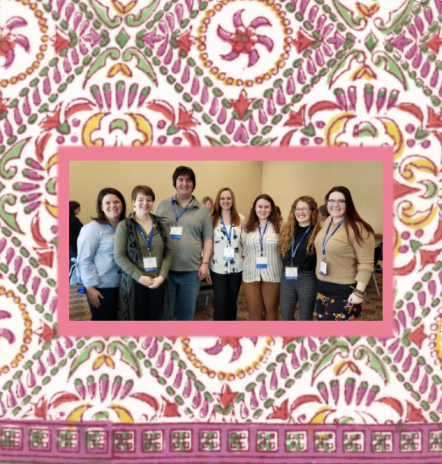
My peers, Dr. E, and I presented our collaborative research at the 2019 New England League of Middle Schools’ annual conference in Providence, Rhode Island (see our crew of nerds above)! Thankfully, our interdisciplinary lesson plans and novels were positively received by current educators who attended our session (which was titled “Let’s Talk!”: Critical Conversations Through YAL Across the Content Areas)!
I previously shared two lesson plans centered around the novels Refugee and Positive: A Memoir. These lesson plans integrate science and ELA, and Grace and I would be so happy if you decided to steal them! (:
Please click here to view the lesson plans Grace and I worked so hard on!
Either way, let’s get back to the WHY behind STEAM + ELA =BFFS!
Think back to that shocking statistic provided by the 2015 PISA exam (Programme for International Student Assessment) that provides data showing students from the U.S are far from leading by example in the subjects of math and science.
Or, check out this graphic:
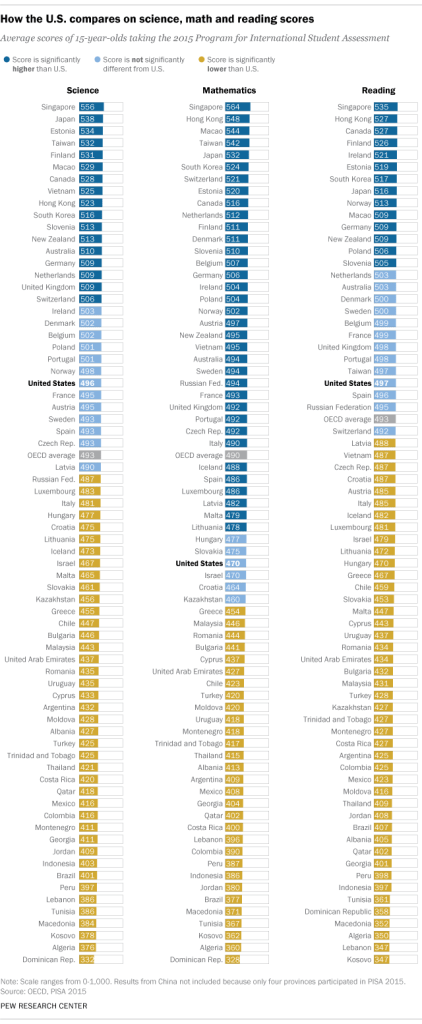
Not only are students underperforming on an international level, but the National Assessment of Educational Progress found that math scores have decreased for 4th and 8th graders in the U.S for the first time since the 1990s.
I have never been one to base a child’s success solely off their test scores, so for the sake of being devil’s advocate let’s say that these scores and statistics do not mean much. Perhaps students in the U.S are in fact grasping STE(A)M…. Maybe the date of the PISA test fell right after a holiday and students were not in the right frame of mind, or maybe students were just having an off day.
Educators and administrators should not be too quick to mark STE(A)M as “done” on their to-do check list just because it is more prevalent today in U.S classrooms. It turns out that STEM has many benefits for students besidesthe intrinsic knowledge it provides within the subjects of math and science.
- Having STEM in the classroom, especially when used to compliment a text, can encourage reluctant readers or students who are more visual and/or kinesthetic learners. Allowing these students to engage in an English text through a lens they are more comfortable with creates both an innovative and inclusive classroom environment.
- The American Association for the Advancement of Science states that a collaboration between ELA and STE(A)M can lead to advanced “reasoning and critical response skills”. Critical response and thinking skills not only help students inside of the classroom, but transfer to life outside of school. Especially in an age where information is readily available and “fake news” seems to be everywhere, students must have the skills to assess and evaluate what is true, false, and how that aligns with their own opinions.
Not only does STEM help in critical thinking, but there is a need and perhaps even more crucial importance on implementing STEM as a way of promoting interdisciplinary learning!
Research has shown (and teachers have noticed) that students find value in interdisciplinary studies, such as paring Science with ELA. When students see that certain concepts translate across disciplines, they may be more likely to realize that lessons learned in ELA do not only apply in a classroom setting. Additional pros to interdisciplinary learning include:
- Student understanding of particular concepts in greater depth
- The promotion of critical thinking
- Student’s learn that a great way to obtain knowledge and gain a more well-rounded viewpoint is through gaining multiple perspectives, and checking those perspectives with other (sometimes conflicting) viewpoints or lenses
Teachers rarely prioritize their own needs, and believe it or not engaging in interdisciplinary practices can benefit teachers in addition to the very students they serve! Teachers who collaborate with one another and utilize interdisciplinary models report feelings of community and satisfaction within their workplace!
Finally, I need to address the “how will this help us in the real-world question” that is bound to be asked when implementing STEAM in an ELA classroom.
- When students graduate and eventually find themselves in the work force, they will be expected to comprehend texts of all types, from informational to literacy texts. As a result, the Common Core states, “Informational reading (as opposed to literary reading) should increase throughout the grades from 50% in 4th grade to 70% in 12th grade.” (ERIC.ED)
- From an ELA stand point, asking students to read informational texts that are commonly found in STEAM does not only help their literacy skills in both informational and literary texts.
- By integrating STEM into the ELA classroom, teachers are adhering to Common Core standards while helping their students prepare for the “real life.”
- From an ELA stand point, asking students to read informational texts that are commonly found in STEAM does not only help their literacy skills in both informational and literary texts.
Okay, okay! We get it, STEM is important and should be implemented in classrooms of various disciplines…
but, how?
Despite the bad wrap that social medias and the internet tend to receive, teachers across the globe have come to love and appreciate the ability to not only communicate but shareand borrowbest practices, even when teaching hundreds of miles apart.
This following section consists of positive testimonials from ELA teachers (mostly at the middle school level) who have created STEM-inspired lesson plans that have changed their classroom practices for the better!
“I’ve learned over the past year that the role of ELA teachers in STEM programming is nothing short of essential”
- Agriculture:
- One teacher reported successful integration of STE(A)M in her ELA classroom when it came to teaching different writing techniques:
- “In the Agriculture Unit, students learned to write attention-getting sentences and use an inverted pyramid structure to organize newsletters about our 500 rainbow trout eggs” (https://tnscore.org/the-role-of-english-language-arts-in-stem/)
- “After our Transportation Unit, students presented vehicle modifications to the Army Corp of Engineers and learned valuable presentation lessons about tone, transitions, and anticipating an audience’s needs” (https://tnscore.org/the-role-of-english-language-arts-in-stem/)
- One teacher reported successful integration of STE(A)M in her ELA classroom when it came to teaching different writing techniques:
- Climatology/Environment:
- Of course, there is an abundance of articles, documentaries, and novels that can be used in the ELA classroom to not only discuss plot and various ELA talking points, but to discuss the ever-important topic of climate change.
- A unit on climate change may also be a great time to teach students how to detect reliable sources… #fakenews…
- Eye of the Storm by Kate
- “In the future, super storms regularly destroy everything in their paths. Jaden’s father is a scientist who has become very rich creating StormSafe shelters for the US government. His Eye on Tomorrow School trains the smartest students for future careers in science. But Jaden learns that her father isn’t the hero that she has always believed him to be, and that she may actually be the one who needs to save others”
- To read more on the use of this novel in a STEM classroom, check this article out!
- Eye of the Storm by Kate
- Personal Antidote:
- The novel Refugee by Alan Gratz:
- The research I mentioned earlier I the article (that was presented at NELMS 2019) involved a multidisciplinary lens on the amazing novel Refugee by Alan Gratz. I feel very strongly about the ability to teach this novel in the classroom (recommended 7thgrade and up) alongside a science teacher, or even in your own class with a STE(A)M lens!
- STE(A)M themes include: travel (mechanics behind boats, planes, trains), weather patterns, various terrains (desserts, oceans, country lands), family lineage, and more.
- Refugee follows three different families on their escape for freedom. One story line follows Josef who is a Jewish boy living in Nazi controlled Germany in the 1930s. He father was taken away and as soon as he returns, they board a ship designed for Cuba and freedom. On this ship we see two perspectives. His father is convinced that everybody who is German on the ship is going to kill them or send them away, while his family feels that they are free to be Jewish and proud once again despite the depicted of Hitler aboard the ship. A second story line is that of Isabel, a young girl from Cuba who is trying to escape with her family in 1994. After riots affect her family and Isabel’s father is threatened they decide to leave Cuba aboard a makeshift raft with another family. The third storyline follows Mahmoud, a young boy from Syria whose home is destroyed in the throes of war. His family flees in 2015. With the use of modern technology, they first leave by car, and then they struggle as they use several different methods to try to escape from war to finally find peace. These stories are all separated by years and by location, but each one still has the same idea; a family trying to find safety and peace. As each story is told, the reader begins to be able to link and untwine how each one of their lives has been affected by another. Each family faces hardships, new locations and betrayals as they go on their journeys that really demonstrate the similarity of each families search for freedom.
- The research I mentioned earlier I the article (that was presented at NELMS 2019) involved a multidisciplinary lens on the amazing novel Refugee by Alan Gratz. I feel very strongly about the ability to teach this novel in the classroom (recommended 7thgrade and up) alongside a science teacher, or even in your own class with a STE(A)M lens!
- The novel Refugee by Alan Gratz:
As mentioned, you too can teach Refugee from a STEAM/ELA lens … check it out here!
- Genetics/Diseases:
Once again, a personal antidote!
- In our research, Grace and I analyzedPositive: A Memoirby Paige Rawland found many teachable moments from both an ELA and a STE(A)M lens (covers themes of genetics, diseases, research for disease prevention and treatment, contracting disease, etc.)
- In our research, Grace and I analyzedPositive: A Memoirby Paige Rawland found many teachable moments from both an ELA and a STE(A)M lens (covers themes of genetics, diseases, research for disease prevention and treatment, contracting disease, etc.)
- As an optimistic pre-teen, Paige enters middle school with a high level of enthusiasm. She is ready to make friends and countless memories, but all of this is halted when she informs a peer of her HIV+ status. Little does Paige know that her HIV+ status carries a weight and stigma with it that turns her from a social teen to a depressed and isolated young woman. Despite bullying and discrimination from peers and teachers alike, Paige rises with the support of her mother, doctors, and true friends. Paige learns to embrace her HIV+ status and becomes a beacon of light for young people who also struggle with bullying and discrimination. This novel tells the story of a courageous young woman who turns years of hardship into motivation to make the world a more understanding and empathic place.
- In our research, Grace and I analyzedPositive: A Memoirby Paige Rawland found many teachable moments from both an ELA and a STE(A)M lens (covers themes of genetics, diseases, research for disease prevention and treatment, contracting disease, etc.)
Don’t forget to check out the lesson ideas for Positive: A Memoir created by my peer Grace and I – check it out here!
- Other Books:
- The Fourteenth Goldfish by Jennifer L. Holm
- “Ellie’s grandfather is a scientist who could be described as crazy. He admits that “All scientists are a little bit mad.” Grandpa Melvin has been searching for the fountain of youth, a cure for aging, and he thinks he’s found it. Ellie has found a passion for science, but also realizes that every choice has consequences” (https://www.middleweb.com/37360/stem-fiction-can-help-energize-ela-classrooms/)
- The Giver:
- Themes of human reproduction, ethics (assisted suicide), afterlife, sociology, coming of age
- The Fourteenth Goldfish by Jennifer L. Holm
- Human Survival:
- Books (Ability to incorporate many dystopian novels):
- Lord of the Flies
- Hunting for food, geography, human survival tactics
- Fahrenheit 451
- Can concentrate on the science behind book burning!
- Incredible teaching ideas from the education blog “Building Book Love”
- Activity “Design a Tiny House”:
- This activity can check for understanding of plot and the settings/environments that characters must navigate.
- This activity can then can teach “procedural writing” though having students create a shelter that their particular character would need in said setting.
- Students would have to first research what environmental factors would play into their house
- After, students would have to learn procedural writing, step by step as to how the structure would be built
- Fun formative assessment = have students follow their peers’ directions and steps. They will collaborate and attempt to create each other’s shelters
- At this point students will get feedback on what steps were unclear in their procedural writing, learning from their mistakes thanks to peer feedback.
- This activity ultimately gives students the opportunity to revise and learn from their mistakes!
- Lord of the Flies
- Books (Ability to incorporate many dystopian novels):
- Overall Methods:
- It seems that STE(A)M and ELA collaboration does especially well with the following methods/aspects of learning in the classroom:
- Project Based Learning:
- The “Design a Tiny House” example above is a perfect example of successful project-based learning in an ELA classroom with a STE(A)M lens!
- Project Based Learning:
- It seems that STE(A)M and ELA collaboration does especially well with the following methods/aspects of learning in the classroom:
- Scaffolding through scientific articles, videos, media:
- Many ELA teachers find themselves dismayed at the lack of freedom in choosing books for their classrooms. Perhaps your school mandates the novels that you can (and therefore cannot) teach. The ability to choose one scientific concept within the book, and to support that concept with articles of varying reading levels, allows the students to channel a different lens in the classroom. It also allows room for differentiation in material and individualized learning!
The above section may seem like content overload, but I only hit a fraction of the materials and lesson plans shared by generous teachers online. I implore you to check out all of the amazing work that ELA, STE(A)M, and history teachers are doing to create a stronger academic community within their schools!
For better or for worse, Common Core Standards are an important part of planning classroom lessons and activities
As a result, it would be amiss to not outline some of the standards that seem to be applicable to the lessons outlined above (and collaborations between ELA and science classes in general):
- Sciences:
- “Natural objects exist from the very small to the immensely large. (5-ESS1-1)”
- “Similarities and differences in patterns can be used to sort, classify, communicate and analyze simple rates of change for natural phenomena. (5-ESS1-2)”
- “5-PS2-1. Support an argument that the gravitational force exerted by Earth on objects is directed down”
- [Clarification Statement: “Down” is a local description of the direction that points toward the center of the spherical Earth.] [Assessment Boundary: Assessment does not include mathematical representation of gravitational force.]
- “ESS1.B: Earth and the Solar System. The orbits of Earth around the sun and of the moon around Earth, together with the rotation of Earth about an axis between its North and South poles, cause observable patterns. These include day and night; daily changes in the length and direction of shadows; and different positions of the sun, moon, and stars at different times of the day, month, and year. (5-ESS1-2)”
- ELA:
- “RI.5.9. Integrate information from several texts on the same topic in order to write or speak about the subject knowledgeably. (5-PS2-1), (5-ESS1-1)”
- “W.5.1. Write opinion pieces on topics or texts, supporting a point of view with reasons and information. (5-PS2-1), (5-ESS1-1)”
- “SL.5.5. Include multimedia components (e.g., graphics, sound) and visual displays in presentations when appropriate to enhance the development of main ideas or themes. (5-ESS1-2)”
- “RI.5.8 . Explain how an author uses reasons and evidence to support particular points in a text, identifying which reasons and evidence support which point(s). (5-ESS1-1)”
I’m curious… what do you think?
Do you have personal experiences with either interdisciplinary learning and/or STEAM?
What was your experience?
Reach out to me (on here or Twitter at @Caroline_Acqua) – I would love to hear your thoughts!
 Empathetic Education