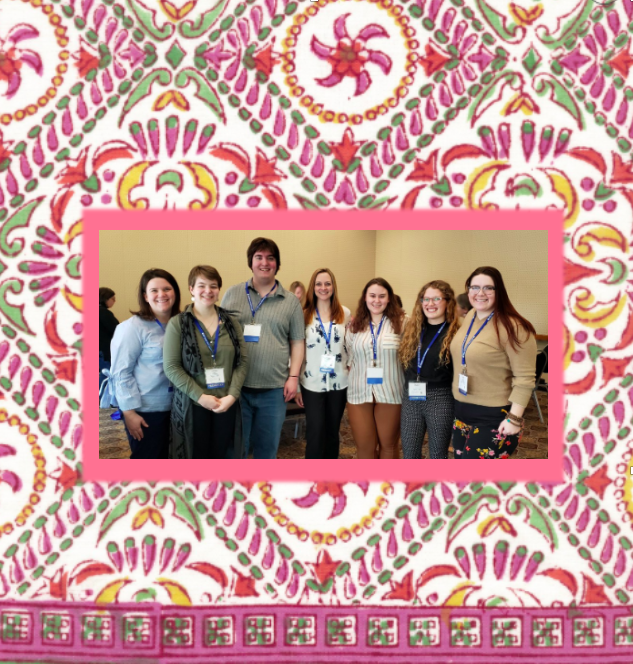
Our team at the New England League of Middle Schools 2019 Annual Conference, presenting on YAL (Young Adult Literature) and interdisciplinary lessons – My partner Grace and I are the two individuals from the right!
As both a student and a teacher, I have always held the concept of hands-on learning close to my heart. The past couple of months I have been researching the importance of interdisciplinary learning for students, and have been able to collaborate on interdisciplinary lessons with my peers at Lesley University. Throughout this process, my love for interactive lessons has come to good use as my peers and I have created hands-on approaches that integrate concepts from both ELA and other subjects, such as science.
As a result, I have outlined a few simple lesson plans/concepts that I hope to use in my own future classroom. Ideally, I would be creating these plans alongside my team’s science teacher to ensure our goals and lessons coincide and compliment each other!
The following lesson plans about the YAL novels Refugee and Positive: A Memoir were created with assistance from my peer Grace, who is studying science and middle school education. Together, we wanted to find YAL novels that could teach both STEAM and ELA concepts in a fun and engaging manner!
Book I: Positive: A Memoir
Rawl, Paige, and Ail Benjamin. Positive: A Memoir. HarperCollins Publishers, 2014.
Book Synopsis
As an optimistic pre-teen, Paige enters middle school with a high level of enthusiasm. She is ready to make friends and countless memories, but all of this is halted when she informs a peer of her HIV+ status. Little does Paige know that her HIV+ status carries a weight and stigma with it that turns her from a social teen to a depressed and isolated young woman. Despite bullying and discrimination from peers and teachers alike, Paige rises with the support of her mother, doctors, and true friends. Paige learns to embrace her HIV+ status and becomes a beacon of light for young people who also struggle with bullying and discrimination. This novel tells the story of a courageous young woman who turns years of hardship into motivation to make the world a more understanding and empathic place.
TW: Domestic Abuse, Bullying, Suicide, Self-Harm (pg. 128).
Essential Questions
Essential Questions that relate the text to the topics of identity/social justice and connect to middle level learners:
- Paige is helped most by those who empathize with her and see her for the loving and optimistic young woman she is. How do you think people can learn to be empathetic? Is it something that can or should be taught in school?
- What myths, or stereotypes, surround Paige and her HIV+ status?
- Some adults within Paige’s life are extremely supportive while others are downright disrespectful.
- In regard to the adults who hurt Paige, how could they have better helped Paige throughout her experiences in school?
- For the adults who supported Paige, what are some of things they said and did that helped Paige overcome her hardships and bullying?
- Paige was isolated, or marginalized, because of her HIV+ status. Reflect on a time where you have felt similar to Paige, and explain how you got through this hard time. Is there something else Paige could have done to help her cope with the bullying?
- While in middle school, many of Paige’s “friends” do not help her when other peers are bullying her, or when teachers make comments about her HIV+ status. What does it mean to be an upstander viruses a bystander?
Content Area Connections
Connections between ELA and Science:
- Scientific Discoveries:
- What is HIV/AIDS (pg. 18)
- Within Part I, “A Short-As-Possible Explanation of HIV”, Paige articulates what it means to have HIV/AIDS, going as far to describe what the disease looks like under a microscope (which can be studied in the science class) while making many of metaphors to better explain the disease (which can be analyzed in the ELA class)
- History of the disease (pg. 21)
- What is HIV/AIDS (pg. 18)
- Transmission of Disease:
- Hereditary spread of HIV/AIDS (pg. 18, 218)
- Characters within the book talking about loved ones who passed along the HIV/AIDS virus – depicted through storytelling.
- Genetics:
- Hereditary spread, how genetics relate
- Other Medical Topics:
- Seizures (pg.116, 124) – The science behind a seizure as well as what it feels like and how it impacts Paige’s life.
- Hereditary spread of HIV/AIDS (pg. 18, 218)
Important Things to Consider
- Trigger Warnings: Although Paige is an overwhelmingly positive person, there are many parts of the book where she mentions dark-times in her past, such as depression, bullying, self-harm, and contemplation of suicide. We firmly believe that the benefits of this book outweigh the negative topics, but strongly suggest you prepare your classroom to discuss and read such heavy subject-matter.
- Bullying: No specific page or chapter, pretty consistent throughout the book
- Self-Harm: pg. 128
- Paige’s writing is fairly informal, with lots of grammatically incorrect sentences (sort of like a stream-of-consciousness). Her writing might be easier for students to read, but some students may be confused as to why the class is reading a book with a less-formal writing style. You may want to talk to your class about the pros and cons of this way of writing.
Teaching Ideas
- Content Area (ELA) Journal Prompts:
- Paige is constantly sharing words of wisdom throughout the novel, such as, “You know how people say that things happen for a reason? I believe it” (p. 27). What is one quote or piece of advice from Paige that you can see yourself using in your day to day life?
- Is Paige’s writing relatable to you as a teenager? Why or why not? Does she write in a certain way that makes the novel easier or more difficult to read?
- Paige has adults in her life, like Dr. Cox, who encourage her and help her through hard times. Is there an adult or trusted person in your community who helps you through hard times? How are they similar or different to Dr. Cox or Paige’s Mom?
- During one of her dark-times, Paige asks, “Why do [people] choose hate?” (pg. 142). Why do you think so many people in Paige’s life were hateful? Can you think of a time in your life when people have chosen hate, and maybe why they did so?
- Paige talks about the many “bystanders”, both adults and students, that watched as she was bullied. If you were in Paige’s school, do you think you would be a bystander or an upstander? How do you think people can learn to be upstanders?
- Content Area (Science) Journal Prompts:
- Paige’s genetics affect her every day in a way that she can notice. How do your genetics affect your life?
- What is the transmission process of HIV? Why is this important?
- If scientists discovered a way to get rid of the HIV/AIDS virus, should they be allowed to change the genetic makeup of an unborn baby? Should scientists be allowed to change a person’s DNA?
Pre, During or Post-Reading Activities you might try with the books
- ELA
- Pre-Reading:
- Upstander Activity:
- Refugee has many instances of bullying. It is important that students learn how to combat bullying through being “upstanders”, which can be taught in the classroom!
- This can be done by watching videos, reflecting on personal experiences, and group discussions to analyze qualities of an upstander.
- The following ideas are adapted from I lesson I found via Common Sense Education, and I highly recommend other educators utilize this resource:
- First as a class discuss what “bullying” means and how students think bullying can be prevented
- Write down all student points on the front whiteboard or on a shared Google Doc.
- If it does not come up organically, talk about “Upstanders” and people who tell bullies that they are wrong, and that upstanders help their peers by supporting them instead of just watching bullying happen
- Show the following video to demonstrate famous figures in history who are “upstanders” who made a difference (“The Power of One”):
- After the video have students Think-Pair-Share about other characters or people in real life that have been upstanders.
- For more details or how to further engage in this lesson plan, please visit:
- Refugee has many instances of bullying. It is important that students learn how to combat bullying through being “upstanders”, which can be taught in the classroom!
- Upstander Activity:
- Pre-Reading:
- Poster Parade Part I:
- Have students walk around with their own markers for a period of 10 minutes or so. Encourage students to write whatever they think when they read the header of each poster (reinforce that everything written down will be read out loud and therefore should be respectful). After the “parade” is done, choose students to read aloud their classmates’ comments under each heading.
- Post-Reading:
- Poster Parade Part II:
- Create identical posters from the initial activity and put them next to the original posters (with student commentary). Once again, give students around 10 minutes to write under each heading, encouraging them to use new knowledge they have obtained while reading “Positive: A Memoir”.
- Once the “parade” portion is done, have students share any new or different responses between the before and after posters. Try to identify any misconceptions students had about certain concepts, such as “HIV”. After this initial comparison a summative assessment can be given; students can write independent responses about their understanding of a certain concept (one of the posters) after the reading, OR you can have students engage in a Socratic seminar to discuss their understandings of topics before and after the novel.
- Create identical posters from the initial activity and put them next to the original posters (with student commentary). Once again, give students around 10 minutes to write under each heading, encouraging them to use new knowledge they have obtained while reading “Positive: A Memoir”.
- Poster Parade Part II:
- Science
- Pre-Reading:
- Research Activity:
- Have students (in groups or independently) create posters of the history of HIV/AIDS.
- Posters will include the facts about discovery, stigmas, and transmission process.
- Research Activity:
- Pre-Reading:
Book II: Refugee
Gratz, Alan. Refugee. Scholastic Press, 2017.
Book Synopsis
Refugee follows three different families on their escape for freedom. One story line follows Josef who is a Jewish boy living in Nazi controlled Germany in the 1930s. He father was taken away and as soon as he returns, they board a ship designed for Cuba and freedom. On this ship we see two perspectives. His father is convinced that everybody who is German on the ship is going to kill them or send them away, while his family feels that they are free to be Jewish and proud once again despite the depicted of Hitler aboard the ship. A second story line is that of Isabel, a young girl from Cuba who is trying to escape with her family in 1994. After riots affect her family and Isabel’s father is threatened they decide to leave Cuba aboard a makeshift raft with another family. The third storyline follows Mahmoud, a young boy from Syria whose home is destroyed in the throes of war. His family flees in 2015. With the use of modern technology, they first leave by car, and then they struggle as they use several different methods to try to escape from war to finally find peace. These stories are all separated by years and by location, but each one still has the same idea; a family trying to find safety and peace. As each story is told, the reader begins to be able to link and untwine how each one of their lives has been affected by another. Each family faces hardships, new locations and betrayals as they go on their journeys that really demonstrate the similarity of each families search for freedom.
Essential Questions
Essential Questions that relate the text to the topics of identity/social justice and connect to middle level learners:
- What does freedom mean?
- How can we learn to be empathic with those who have had to leave their lives behind in for the chance of freedom?
- How does technology play into the role of people searching for freedom?
Content Area Connections
Connections between ELA and Science:
- Connecting the two subjects is more about creating a deeper understanding scientifically what each family had to go through by both reading the text and learning some of the underlying science.
- Different means of travel and why they were chosen
- Each family picks a mean of travel that works and is the only way for them to try to get out. Both Isabel and Josefs family take boast but they are very different boats and Mahmoud’s family uses many different methods. (Pgs. 34, 40, 49) These are the second chapter of each family’s story line.
- There is specific reasons such as where they are going, safest way, only way that play in but also geophysical and scientific elements such as the lay of the land or the safest/ least threatening way.
- There is an inciting incident that causes each family to make that the time to leave.
Important Things to Consider
- Trigger Warnings: While this book focuses on the aspect of tomorrow for each of the children and the chance at freedom, for each child their are many costs to get their.
- Death
- Bombings
- War
- Hate crimes/speech
- Explicit depictions (ex. Pg. 71, when one student witness somebody being killed/states a bullet hole through head)
- Mental Illness (throughout the book serval people are described as sick or broken)
- Generally deep and heavy for middle schoolers, may not be appropriate for all middle schoolers.
Teaching Ideas
- Content Area (ELA) Journal Prompts:
- Each character within Refugee talks about the importance of family. What role does your family play in your life?
- Although Isabel, Josef, and Mahmoud all live in different time periods and countries, what are two central themes that all the characters experience?
- Do you think it is helpful or confusing that the author goes back and forth between all of the character’s perspectives, changing from chapter to chapter? Why do you think the author chose to write in this style?
- After reading Refugee, what part of the book stood out to you the most?
- What do you think that governments can do to help refugees like the characters we read about? Do you think the government needs to help refugees from other countries, why or why not?
- Content Area (Science) Journal Prompts:
- Both Isabel and Josef escape by means of water. What is similar about their journeys and what is different?
- On Page 72, Mahmoud’s father goes back to the car for their iphone and charger. Why do you think this device was so important to their journey?
- Compare and Contrast each journey.
- If you had to leave, what do you think would be the most difficult elements such as storms or big waves you would face? Why would this one be the most difficult for you?
Pre, During or Post-Reading Activities
- Science:
- Pre-Reading:
- Think-Pair-Share or Whole-Class Discussion:
- Talk about the time period and mental health issues. Make sure the students are aware that the book features
- During-Reading:
- Mapping:
- Start a map of each character’s journey
- Assign each family a color and as you read continue the map, following their journeys and pivotal moments for the search for freedom.
- Simulation:
- Reimagine the rafts used in Refugeeusing popsicle sticks and a large bucket of water. Have each student try to make a raft that they think will hold up to the waves and the wind without sinking or capsizing. Students will all draw up their diagram and make a list of different elements (such a waves, storms, lightning) that they believe they would have to stand up against.
- Mapping:
- Think-Pair-Share or Whole-Class Discussion:
- Pre-Reading:
- ELA:
- Pre or During Reading Activity:
- Letter Writing:
- Have students put themselves in the shoes of one of the characters (or make up their own with similar struggles as those in Refugee). Write a letter to a government of a foreign country and explain why that country should let “you” (the student) and other refugees into the country.
- This activity can incorporate research on 21st century countries that deny refugee asylum.
- Both:
- During:
- Journaling:
- Students can periodically write from the perspective of one of the characters from Refugee. While doing this, they can map out the journey (and where they physically are at the time of that journal entry), which plays into the scientific components.
- Journaling:
- During:
- Letter Writing:
- Pre or During Reading Activity:
 Empathetic Education